Our Mission & Vision
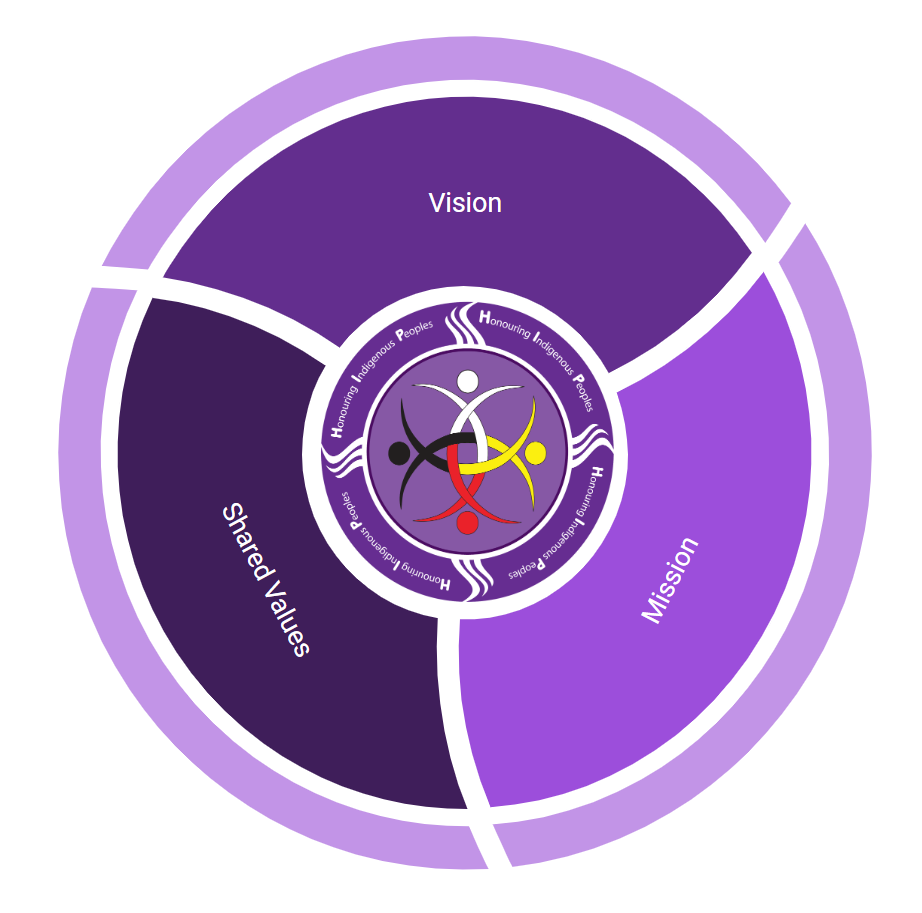
Our mission is to change society by building sustainable relationships between Indigenous & Non-Indigenous peoples, strengthening community well-being, and advancing the next generation of leaders.
Our vision is all Indigenous and Non-Indigenous Peoples working and learning together, interconnected and interdependent, for the benefit of future generations.
Our story
“We walk together to forge a new path”
Cree-Métis & HIP Board Member
Every organization has an origin story. Ours starts in a basement.
In 2014, a small group of Rotarians from communities across Southern Ontario found their way to a basement in Oshawa. Nothing about the room suggested history was being made. No cameras, no press release, no five-year strategic plan on a slide deck. Just a handful of people who believed Canada needed something that didn’t exist yet: a national organization built to walk alongside Indigenous Peoples, not for them, not around them, alongside.
They didn’t start with an org chart. They started with a rough sketch on paper and a decision that would shape everything that followed: before doing anything, they would sit and listen.
So they did. Circle after circle, community after community, they showed up to listen before they showed up to propose. Seeking first to understand. Asking, again and again, how a genuine partnership should even begin – because that’s not a question you get to answer for someone else.
Step by step, they walked the path. The first real test of whether they meant what they said wasn’t a mission statement. It was the board table. They committed to a board that was 50% Indigenous and 50% Rotarian, gender-balanced, and drawn from coast to coast – not as an aspiration to grow into someday, but as the starting condition.
That decision made things harder, not easier. When the board itself came together, the conversations got tough – tough enough that there were moments it felt like agreement might never come, moments where quitting would have been the easier road. Learning to build trust, share power, and actually work together – across different histories, different experiences, different starting points – doesn’t happen on anyone’s convenient timeline, and it didn’t happen on theirs either. What turned it around wasn’t a compromise or a vote. It was the moment everyone in that room realized they were all pulling toward the same thing: a genuine, shared passion for supporting the next generation. Once that became clear, the disagreements didn’t disappear, but they stopped being the point. Nobody quit. What came out the other side was a board that was stronger for having had those hard conversations – not because they were smoothed over, but because they weren’t.
That basement conversation became HIP’s multi-year plan. That plan became the Youth-to-Youth Gathering. And the same principle that started it all is still the one we operate by today: we stay attentive to the voices and wisdom of our Indigenous and non-Indigenous partners, and we keep reflecting, adapting, and building on what’s working.
Twelve years on, that collaboration is still standing, still growing, and still run by people who’d rather listen than lecture. As Indigenous and non-Indigenous allies, our commitment to working together hasn’t wavered. As HIP grows, that means more Indigenous and non-Indigenous people joining the circle, more relationship-building between communities and organizations, more time spent finding common ground and shared values. It’s slow, deliberate work. It’s also, we think, exactly how you build a stronger, more inclusive country – one relationship, one circle, one fire at a time.
One fire. One people. One future.
Our Logo
Our logo was designed by Jennifer Wemigwans, Anishnaabekwe (Ojibwe/ Potawatomi) from Wikwemikong First Nation. The four colours of the medicine wheel represent many things. In this specific design we are using the symbolic image of people and the four colours to represent the four races of human kind. They are intertwined and inter-related to symbolize that we are all dependent upon one another and that only together do we represent the strength of the circle – a complete unity. The outer circle that envelops the four races is done in purple and white to pay homage to and acknowledge the importance of wampum belts and their historical bond for bringing together people in this land. Traditional wampum beads are a blend of white and purple. The waves emitting out from the circle symbolize the ripple effect and strength that comes from being united as people.